For most Americans, prices at the gas pump represent one of the most visible and immediate ways that geopolitical conflict in the Middle East touches their daily lives. Gasoline prices are prominently displayed and frequently updated, and fueling up at least once a week is a necessity for commuting, running errands, and managing daily routines. Diesel prices matter equally, as they influence the cost of transporting and manufacturing goods throughout the economy. These factors make energy prices key economic indicators and help explain why the ongoing situation in the Middle East has become a growing concern for both consumers and investors.
With conflict now entering its second month and daily headlines alternating between potential peace agreements and possible escalation, oil prices remain elevated with significant intraday swings. Brent crude is trading above $110 per barrel and WTI above $100, meaning higher energy costs will weigh on household budgets, inflation readings, and Federal Reserve policy decisions.
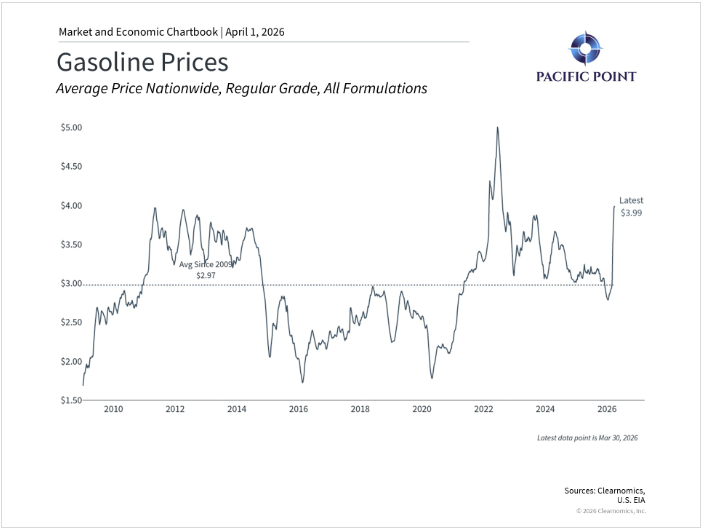
The national average for regular unleaded gasoline has climbed to approximately $4.00 per gallon, rising by more than a dollar per gallon within just one month. Although this remains below the record high of $5.00 per gallon reached in 2022, it could worsen if oil prices stay elevated. For most households, filling up is a nonnegotiable expense. A straightforward calculation illustrates the impact: assuming an average fill-up of 15 gallons, the current price increase adds $15 per visit. For those filling up weekly, this translates to roughly $780 less per year in disposable income.
The effects are both direct and indirect. At the federal minimum wage of $7.25 per hour, that $780 represents more than two extra hours of work just to break even. For the median American household, which earns just over $70,000 per year after taxes according to the latest Census Bureau data, the added cost exceeds 1% of after-tax income. While manageable for most, higher gasoline prices effectively reduce the funds available for discretionary spending or savings.
From an investment perspective, the cumulative drag on the economy can be meaningful. When multiplied across millions of households week after week, the impact on consumer spending and savings rates becomes significant if oil prices remain high. The indirect effects may be even more consequential, as gasoline and diesel are fundamental inputs for transportation, manufacturing, agriculture, and distribution, meaning higher fuel costs can ripple broadly across the economy over time.
According to the U.S. Energy Information Agency, roughly half of the price at the pump reflects crude oil costs, while the remainder consists of refining costs, transportation, distribution, marketing expenses, and federal and state taxes. This is partly why there is not a one-to-one relationship between oil prices and pump prices, and why consumers in certain states pay considerably more than the national average.
For investors, it is also notable that the oil futures curve is currently deeply “backwardated,” meaning that oil prices are much higher today than they are expected to be in the future. This signals that traders view the current spike as a temporary supply disruption rather than a permanent shift to higher prices. While this does not guarantee a swift resolution, it does suggest the market anticipates stabilization once conditions in the Middle East improve.
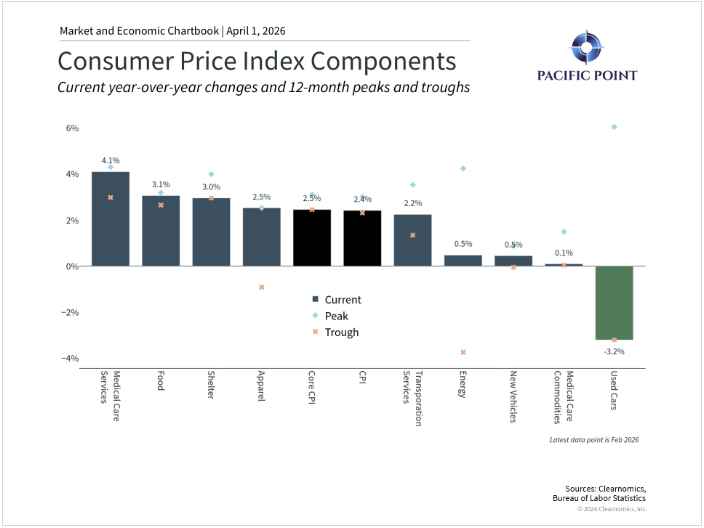
Energy prices are important components of the headline Consumer Price Index, and the recent jump in oil and gasoline prices will almost certainly push headline inflation higher in the coming months. Organizations such as the OECD now estimate that U.S. inflation could rise faster than expected this year. This matters because consumers are still recovering from the post-pandemic inflation surge, and rising inflation has historically created headwinds for both stocks and bonds.
Perhaps most relevant for financial markets, higher inflation complicates Federal Reserve decision-making. Markets have already shifted expectations, with traders now assigning a greater probability to the Fed holding rates steady or even raising them rather than cutting. This shift has introduced additional uncertainty for equity and bond markets, particularly as the Fed navigates a leadership transition in mid-May.
That said, the current environment is notably different from the 1970s energy crisis. The U.S. is now the world’s largest oil and natural gas producer, the Fed has significantly more credibility in anchoring inflation expectations, and markets have shown considerable resilience in challenging environments. For investors, maintaining a well-constructed portfolio and staying committed to a long-term financial plan remains the most prudent approach—just as it proved effective during the 2022 inflation spike.
Rising gasoline prices are a burden for consumers and will likely push headline inflation higher in the near term. However, history demonstrates that markets and the broader economy have successfully navigated past energy shocks, and investors are best served by maintaining a long-term perspective and staying focused on their financial plans.